A few years ago, I decided to repaint my entire living room myself. I bought what I thought was a good flat white paint for both the ceiling and walls to save time and money. Big regret. The ceiling looked patchy with roller marks, paint dripped constantly, and the walls scuffed within months. That project taught me an important lesson: paint for ceilings and paint for walls are not the same thing.
Why Ceiling Paint and Wall Paint Are Formulated Differently?
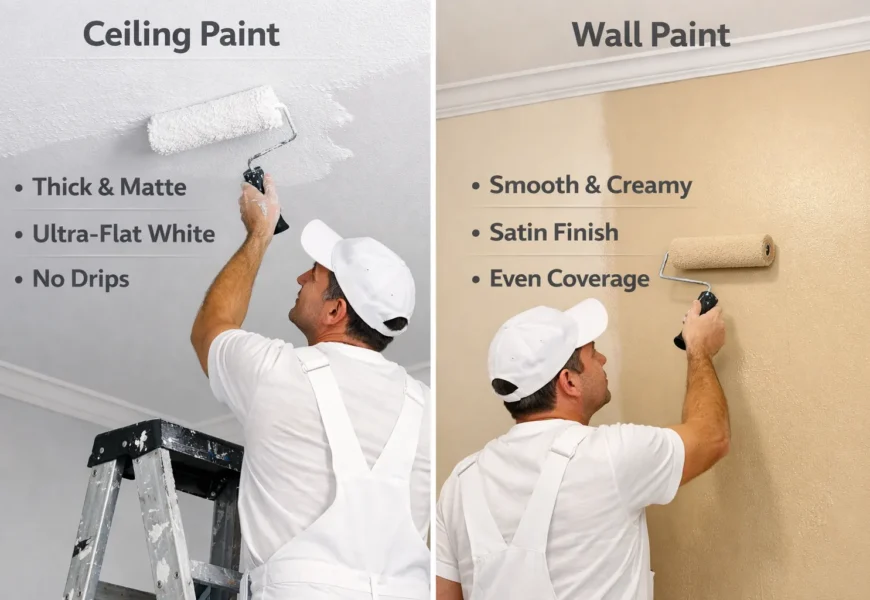
The core difference starts with viscosity — how thick or thin the paint is. Ceiling paint is noticeably thicker, almost like yogurt. This thickness is deliberate. When you’re working above your head, gravity works against you. Thicker ceiling paint stays on the roller and ceiling instead of dripping down onto your face, hair, or freshly painted walls.
Wall paint has a thinner, smoother consistency, more like milk. This allows it to flow and level out nicely on vertical surfaces, giving you a clean, even finish without visible lap marks or streaks.
Finish Matters More Than Most People Realize
Finish is where the biggest visual and practical differences show up. Most ceiling paints are ultra-flat matte with zero sheen. This non-reflective surface does an excellent job of hiding imperfections like popcorn texture, drywall seams, cracks, and uneven lighting. It also minimizes glare from ceiling lights and fans, making the room feel calmer.
Wall paint comes in various sheens — eggshell, satin, semi-gloss, and sometimes high-gloss. The slight sheen serves a practical purpose. Walls get touched, bumped into, and cleaned regularly. A satin or eggshell finish makes it much easier to wipe away fingerprints, scuffs, and dirt without damaging the paint.
Durability and Real-World Performance
Ceiling paint focuses on coverage and stain blocking rather than toughness. It usually contains more fillers, which helps it cover well in one coat and hide water stains from leaks. However, it lacks strong binders, so it’s not very scrub-resistant. Trying to clean it often removes the paint.
Wall paint uses higher-quality resins and binders, making the dried film much more durable. It stands up better to daily wear and tear — kids’ handprints, pet scratches, furniture marks, and frequent cleaning. This is why wall paint generally costs more.
Cost and When You Can Bend the Rules
Ceiling paint is typically cheaper per gallon because the formula is simpler. Many brands market it as the smart budget choice for large overhead areas. While this saves money initially, using ceiling paint on busy walls often means repainting sooner.
In low-traffic areas like closets, guest bedrooms, or basements, some homeowners successfully use ceiling paint on walls for its uniform flat appearance. But in kitchens, bathrooms, hallways, or family rooms, it’s best to use the right paint for the surface.
Final Tips Before You Start Painting
Next time you’re at the paint store, don’t just reach for any white can. Read the labels carefully. Consider how much traffic the surface gets, how much light hits it, and how often it will need cleaning. Choosing the correct paint from the beginning will save you time, frustration, and money in the long run.
FAQs About Paint for Ceilings and Walls
Can I use ceiling paint on walls? Yes, but only in low-traffic areas like closets or storage rooms. Ceiling paint scuffs easily and doesn’t clean well on walls.
Can wall paint be used on ceilings? It’s possible, especially on smooth ceilings. However, expect more drips and less effective hiding of imperfections compared to dedicated ceiling paint.
Which paint hides stains better? Ceiling paint is generally better at hiding water stains and discoloration on ceilings due to its strong stain-blocking properties.
Is there a big price difference? Ceiling paint is usually 10–30% cheaper than wall paint. The savings add up on large ceilings, but performance differences often matter more than cost.
Does ceiling paint dry faster? Drying time depends more on temperature and humidity than the label. However, thicker ceiling paint can sometimes feel like it sets up quicker.
Last modified: April 4, 2026