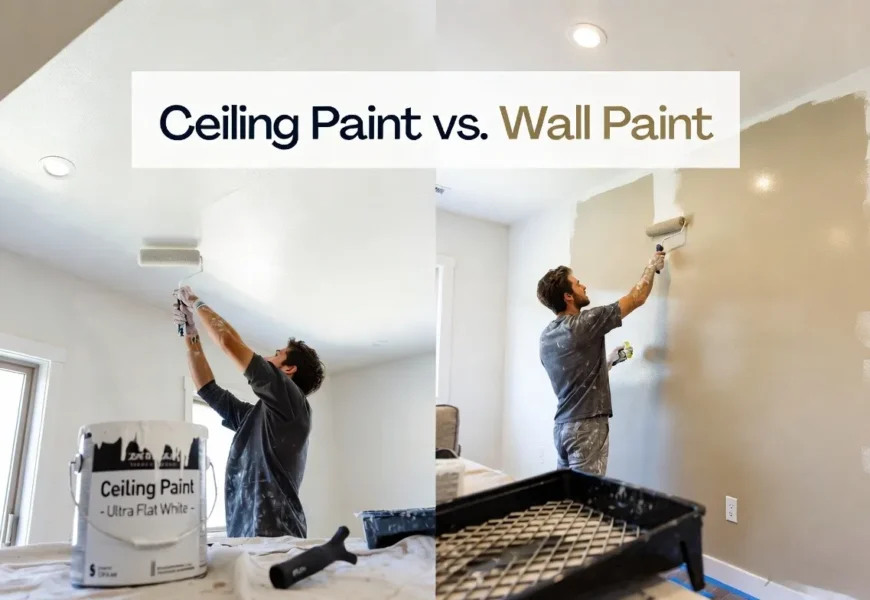
Last summer I helped a friend repaint his 1980s ranch house. We were halfway through the living room ceiling when I realized the “flat white” we grabbed off the shelf was actually wall paint. Big mistake. It splattered like crazy, showed every roller mark under the track lighting, and took forever to dry. That painful experience taught me a valuable lesson: ceiling paint and wall paint aren’t just marketing gimmicks. They’re formulated differently because ceilings and walls face completely different challenges.
Why the Formulas Are Different?
The most noticeable difference hits you the moment you stir the can — viscosity. Ceiling paint is much thicker, almost like Greek yogurt, while standard wall paint flows more like whole milk. This extra thickness is intentional. When you’re working overhead, gravity is your enemy. Thicker ceiling paint clings to the roller and stays where you put it instead of dripping onto your head, shoulders, or freshly painted walls. Wall paint, being thinner, spreads and levels smoothly on vertical surfaces, giving you that beautiful, even finish without brush or roller marks.
Finish: The Role of Sheen (or Lack of It)
Finish plays a huge role in both performance and appearance. Almost all ceiling paints are formulated as ultra-flat matte with zero sheen. This non-reflective surface is perfect for hiding imperfections — popcorn ceilings, drywall tape lines, cracks, and shadows from overhead lighting all seem to disappear. It also reduces glare from recessed lights and ceiling fans, making the room feel softer and more comfortable.
Wall paints, on the other hand, come in a range of sheens: eggshell, satin, semi-gloss, and even high-gloss. The slight sheen serves a practical purpose. Walls get touched, bumped, and cleaned far more often than ceilings. A satin or eggshell finish makes it easier to wipe away fingerprints, scuffs, and dust without damaging the paint film. It also gives walls a more polished, contemporary look that flat paint simply can’t match.
Durability and Long-Term Performance
Durability is another area where the two paints diverge significantly. Ceiling paint prioritizes coverage and stain-blocking over toughness. Manufacturers load it with fillers like clay and calcium carbonate, which help it cover in one coat and hide water stains from roof leaks or plumbing issues. However, because it has fewer binding resins, it’s not very scrub-resistant. If you try to wash ceiling paint, you’ll often end up removing it.
Wall paint invests more in durable acrylic or latex binders. This makes the dried film tougher and more resistant to everyday wear and tear — kids’ handprints, pet fur, furniture scratches, and frequent cleaning. That’s why professional painters often recommend spending a bit more on quality wall paint for high-traffic areas.
Cost Considerations and Smart Choices
Price is one area where ceiling paint usually wins. Because the formula is simpler and contains more fillers, a gallon of ceiling paint is typically cheaper than a comparable gallon of wall paint. Many brands position ceiling paint as the budget-friendly option for large overhead surfaces.
That said, using the wrong paint to save money is a false economy. Applying ceiling paint on walls in a busy family room or hallway will likely mean repainting within a few years. On the flip side, you can sometimes use a good flat wall paint on a smooth ceiling in a low-traffic room, though you may deal with more drips and less effective hiding of imperfections.
When Can You Bend the Rules?
In practice, many homeowners and even some painters bend the rules in certain situations. I’ve seen people successfully use ceiling paint on closet walls or in rarely used guest bedrooms because they love the uniform flat look. In basements or utility rooms, the choice becomes even more flexible. But in kitchens, bathrooms, kids’ rooms, or main living areas? It’s best to stick with wall paint designed for vertical surfaces.
Final Tips for Your Next Painting Project
The next time you’re staring at rows of white paint cans in the store, take a minute to read the labels carefully. Think about how the surface will be used, how much light hits it, and how often it will need cleaning. Choosing the right paint from the start will save you time, frustration, and money in the long run. A weekend painting project should leave you feeling proud of the results — not exhausted from fighting drips and poor coverage.
FAQs About Ceiling Paint vs Wall Paint
Can I use ceiling paint on walls?
Technically yes, but it’s not recommended for most living areas. Ceiling paint on walls tends to scuff easily and doesn’t clean well. It works better in low-traffic spots like closets or storage rooms.
Can I use wall paint on the ceiling?
You can, especially if the ceiling is smooth and in good condition. However, expect more drips, slower coverage, and less ability to hide imperfections. Flat or matte wall paint performs better than satin or glossy versions for ceilings.
Is ceiling paint better at hiding stains?
Yes. Most ceiling paints are formulated with excellent stain-blocking properties, making them ideal for covering water marks or smoke damage on ceilings.
Does ceiling paint dry faster?
Not necessarily. Drying time depends more on the brand and environmental conditions (temperature and humidity) than on whether it’s labeled ceiling or wall paint. However, because ceiling paint is thicker, some people find it feels like it sets up quicker.
Is there a big price difference?
Ceiling paint is usually 10–30% cheaper per gallon than wall paint from the same brand. The savings add up when painting large ceiling areas, but the performance trade-offs matter more than the initial cost.
Last modified: April 4, 2026