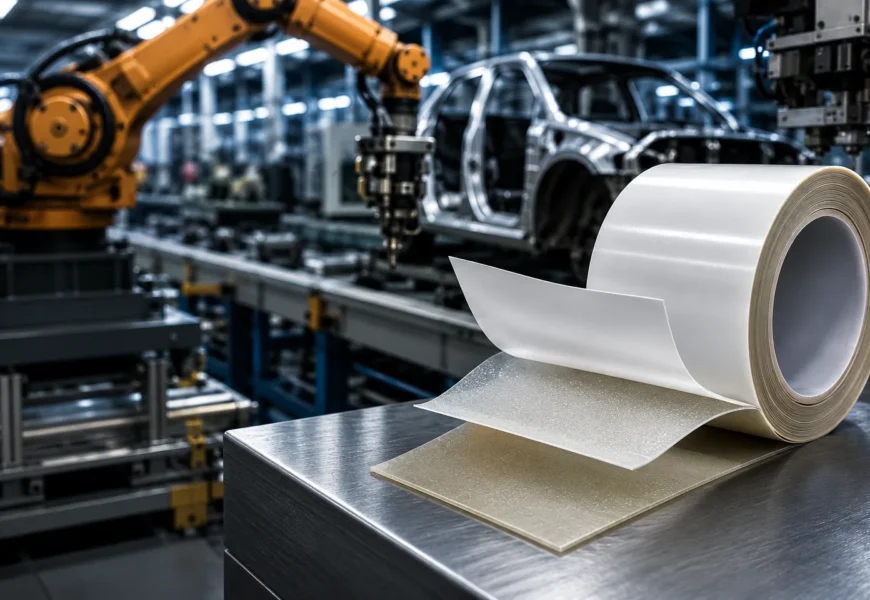
Modern manufacturing rarely joins two pieces of the same material. A production line might need to bond aluminum to silicone foam, glass to plastic, or a painted metal panel to a polyester film — all on the same assembly. A single adhesive formula is almost never optimized for both surfaces at once. That’s the exact problem differential adhesive tapes were engineered to solve.
This guide breaks down what differential adhesive tapes are, the science behind how they work, the materials that go into them, and the industries that depend on them every day.
What Is a Differential Adhesive Tape?
A differential adhesive tape is a double-sided pressure-sensitive tape built with two different adhesive formulations — one on each face of a shared carrier or backing layer. Instead of coating both sides with the same adhesive, manufacturers “tune” each side independently so it performs its best against a specific substrate.
In a typical construction:
- Adhesive Layer A (Side 1) — optimized for one material, such as steel, glass, or painted surfaces
- Carrier/Backing — a film, foam, or fabric layer that holds everything together and gives the tape its mechanical properties
- Adhesive Layer B (Side 2) — optimized for a different material, such as silicone rubber, low-surface-energy plastics, or foam
- Release liners — removable protective films on each face, peeled away just before bonding
Because each side is chemically distinct, the tape can form a strong bond on both surfaces simultaneously, even when those surfaces have completely different chemistries.
Also check our article on Does american furniture warehouse have military discount?
How Differential Adhesive Tapes Actually Work
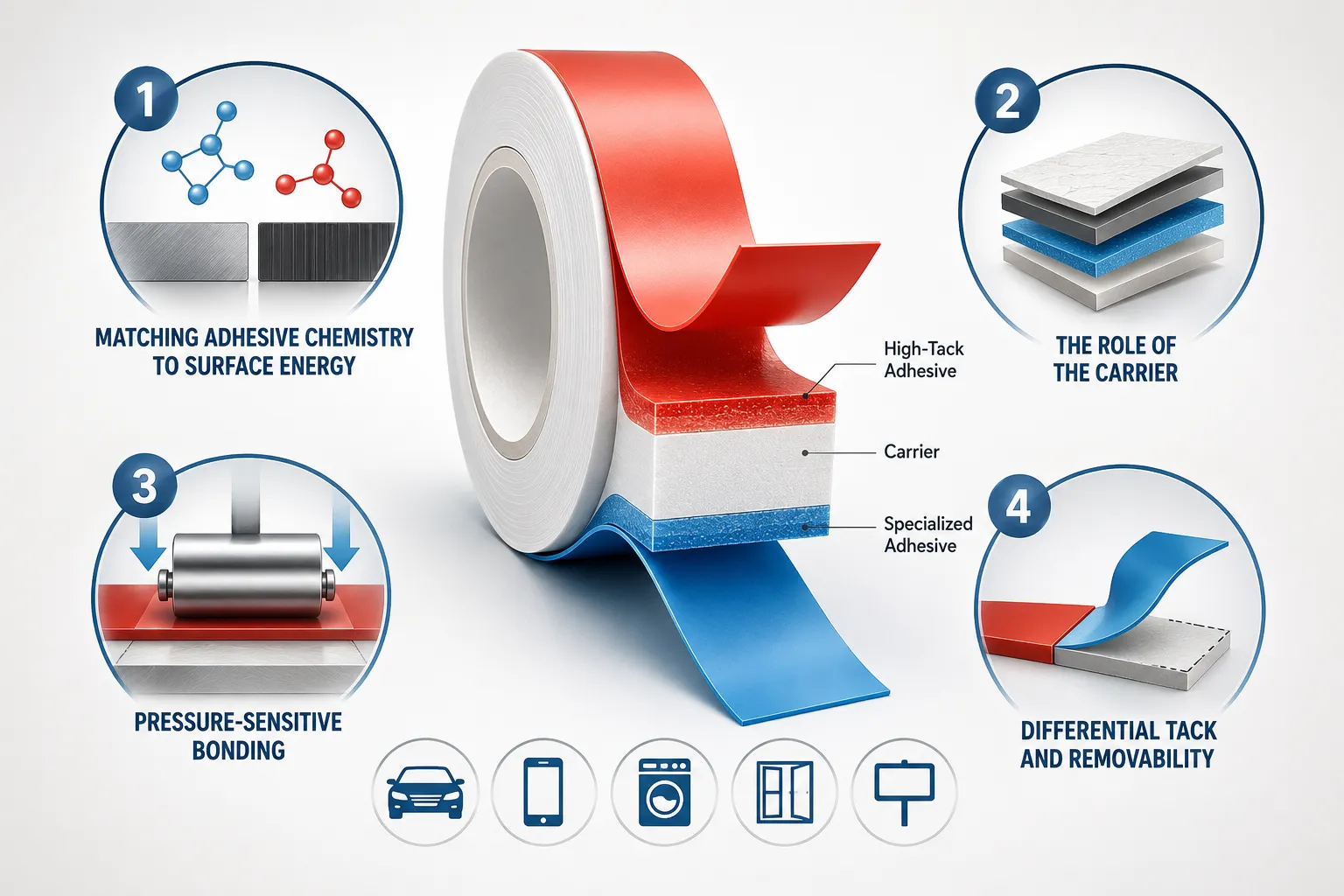
1. Matching Adhesive Chemistry to Surface Energy
Every material has a “surface energy” that determines how easily an adhesive wets and grips it. Metals, glass, and painted surfaces are high-surface-energy materials, which most adhesives bond to fairly easily. Silicone rubber, polyethylene, polypropylene, and many powder-coated finishes are low-surface-energy materials that resist most conventional adhesives.
A differential tape solves this by pairing:
- A high-tack, general-purpose adhesive (often acrylic or rubber-based) on the side that meets a “normal” high-energy surface
- A specialized adhesive (frequently silicone-based) on the side that meets a low-energy or heat-resistant surface
The result is uniform adhesion performance across two surfaces that would otherwise require two separate bonding processes.
2. The Role of the Carrier
The carrier sits between the two adhesive layers and is far more than a spacer. It determines:
- Conformability — how well the tape flexes around curves, ridges, or textured surfaces
- Dimensional stability — resistance to stretching, shrinking, or tearing during application
- Thermal and chemical resistance — how the tape holds up under heat, oils, solvents, or UV exposure
- Overall tape thickness — important for gap-filling or maintaining precise assembly tolerances
Common carriers include polyester (PET) film, polyethylene foam, polyurethane foam, acrylic foam, and nonwoven fabrics, each chosen based on the mechanical demands of the application.
3. Pressure-Sensitive Bonding
Like all PSA (pressure-sensitive adhesive) tapes, differential tapes don’t require heat, solvents, or curing time to form a bond. Applying moderate hand or roller pressure is enough to make the adhesive flow into the microscopic texture of each surface, creating mechanical and chemical anchoring almost instantly. Full bond strength typically builds over 24–72 hours as the adhesive continues to wet out the surface.
4. Differential Tack and Removability
Some differential tapes are intentionally designed with one high-tack (permanent) side and one low-tack (removable/repositionable) side. This is common in applications like flooring installation, signage, or prototyping, where one surface needs a permanent bond while the other needs to be repositioned or peeled away cleanly without leaving residue or damaging the substrate.
Common Adhesive Combinations Used in Differential Tapes
| Combination | Typical Use Case |
|---|---|
| Silicone / Acrylic | Bonding silicone rubber, foam, or gaskets to metal, glass, or plastic |
| Acrylic / Rubber | General industrial bonding where cost and versatility matter |
| High-shear Rubber / General-purpose Rubber | Bonding foams to low-surface-energy plastics in appliances |
| High-tack Acrylic / Low-tack Acrylic | Repositionable applications like flooring, signage, and graphics |
Silicone/acrylic differentials are especially valued because silicone adhesive bonds tenaciously to silicone-coated materials, sponges, and rubbers — surfaces almost nothing else sticks to reliably — while the acrylic side handles common engineering materials such as steel, aluminum, and painted panels.
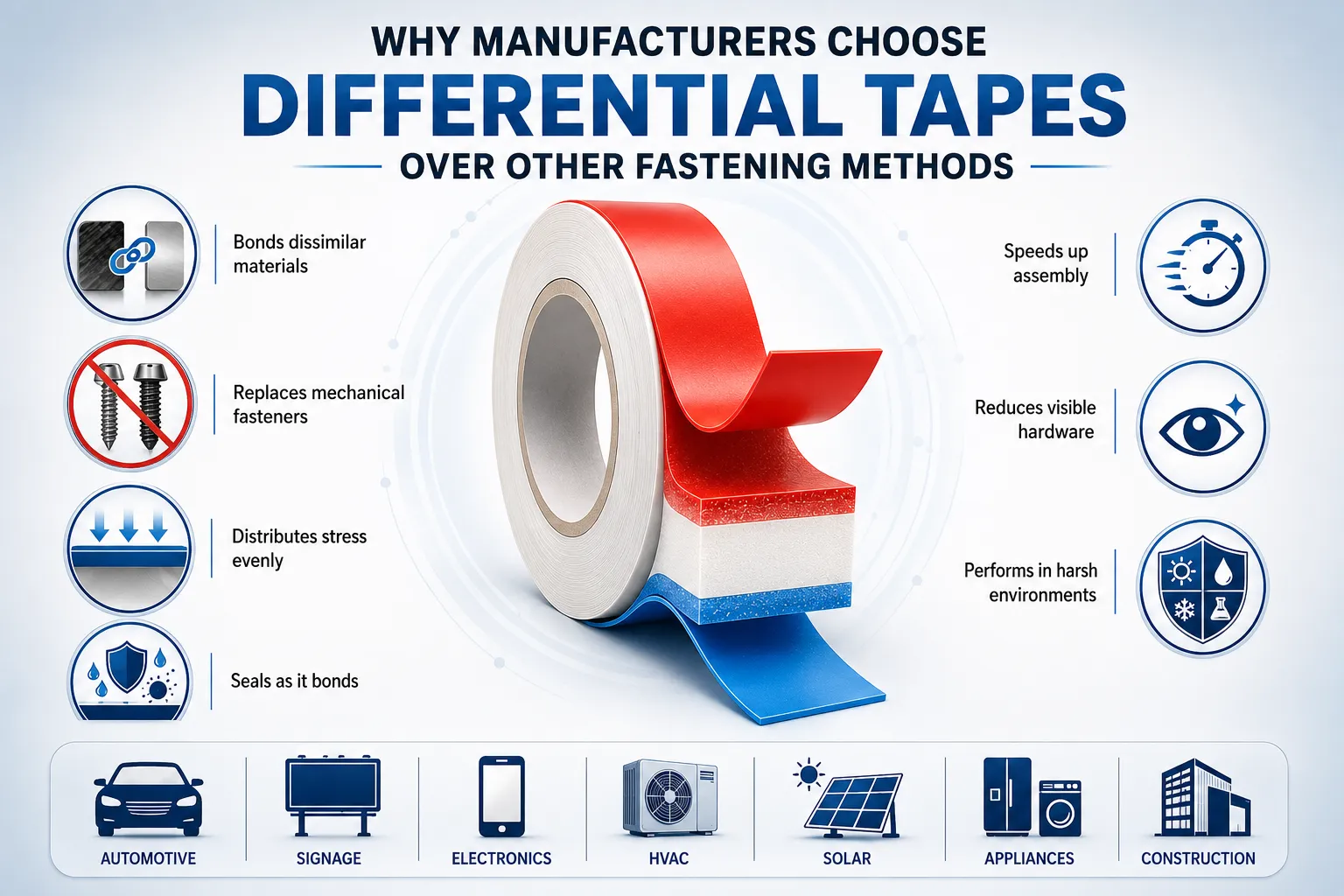
Why Manufacturers Choose Differential Tapes Over Other Fastening Methods
- Bonds dissimilar materials that a single adhesive can’t handle well on its own
- Replaces mechanical fasteners (screws, rivets, welds) without drilling, heat distortion, or added weight
- Distributes stress evenly across the bond line instead of concentrating it at fastener points
- Seals as it bonds, keeping out moisture, dust, and vibration-related wear
- Speeds up assembly since there’s no curing, clamping, or drying time required
- Reduces visible hardware, which matters for aesthetics in automotive trim, signage, and consumer electronics
- Performs in harsh environments, including temperature extremes, UV exposure, humidity, and chemical exposure, depending on the formulation chosen.
Also check our article on Does home depot carry floor mat grip tape trackid sp-006?
Industrial Applications of Differential Adhesive Tapes
Automotive Manufacturing
Differential tapes are widely used to mount emblems, badges, trim, weatherstripping, and body-side moldings directly onto painted panels — replacing rivets and clips while giving a flush, seamless appearance. They also bond foam gaskets and rubber seals to metal housings under the hood and in the cabin.
Electronics and Membrane Switches
Thin differential tapes act as spacers and bonding layers in membrane switches and touch panels, where the tape must survive thousands of flex cycles, allow light transmission, and tolerate temperature swings without losing adhesion.
Appliance and General Industrial Manufacturing
Differential tapes bond foam gaskets, insulation, and trim components to plastic and metal appliance housings, often replacing spot welding or liquid adhesives that require curing ovens.
Aerospace
High-performance silicone/acrylic differentials are used where components must bond to both silicone-based sealants or rubber and structural metals, all while withstanding extreme temperature cycling.
Construction and Flooring
A high-tack side bonds carpet, vinyl, or flooring material to a surface, while a low-tack side allows the tape itself to be repositioned or removed cleanly during installation.
Signage, Graphics, and Prototyping
Repositionable differential tapes let designers place and adjust graphics, mockups, or display components before committing to a final, permanent bond.
Medical Device Assembly
Differential tapes bond dissimilar components such as silicone tubing, foam padding, and plastic housings in wearable and diagnostic devices, often in cleanroom-compatible formulations.
How to Choose the Right Differential Adhesive Tape
When specifying a differential tape for an industrial application, consider:
- The two substrates being joined — identify the surface energy and texture of each
- Environmental exposure — temperature range, UV, moisture, chemicals, or outdoor weathering
- Required bond type — permanent on both sides, or permanent on one and repositionable on the other
- Carrier thickness and type — foam for gap-filling and cushioning, film for thin, precise bond lines
- Application method — hand application, die-cutting, or automated dispensing on a production line
- Regulatory or industry requirements — such as flame-retardancy ratings, medical-grade certifications, or automotive OEM specifications
Frequently Asked Questions
Is a differential tape the same as a standard double-sided tape? No. A standard double-sided tape uses the same adhesive on both faces. A differential tape deliberately uses two different adhesive formulations, one per side, to optimize bonding to two different materials.
Can differential tapes be removed without damage? It depends on the design. Tapes with a low-tack side are made for clean removal, while tapes with high-tack adhesive on both sides are intended as permanent, structural bonds.
Do differential tapes need clamping or curing time to work? No curing is required, but most differential tapes benefit from firm application pressure and reach their full bond strength within 24 to 72 hours as the adhesive continues to wet the surface.
What industries use differential adhesive tapes most? Automotive, electronics, appliance manufacturing, aerospace, construction, signage, and medical device assembly are the heaviest users, largely because these industries routinely join dissimilar materials.
Conclusion
Differential adhesive tapes exist because real-world manufacturing rarely involves bonding identical materials. By pairing two purpose-built adhesive chemistries on a single carrier, these tapes deliver strong, reliable, and often repositionable bonds across dissimilar substrates — all without welding, drilling, or mechanical fasteners. For engineers and production teams looking to simplify assembly, cut weight, and improve durability, differential tapes have become one of the most practical bonding solutions in modern industry.
Last modified: July 13, 2026