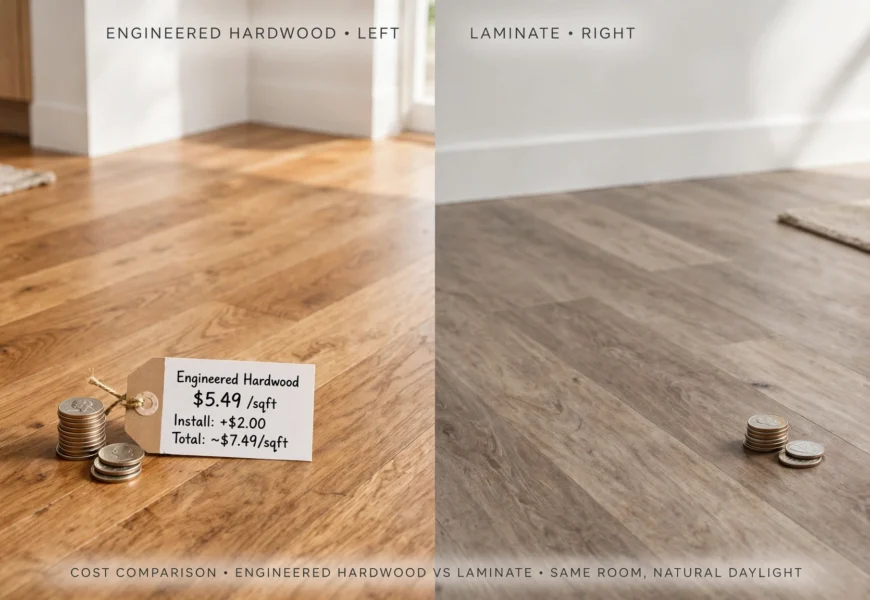
If you’ve already read up on how engineered hardwood and laminate flooring are built, the next question is almost always the same: what does each one actually cost, and which one is the smarter money decision for my specific room? This guide skips the construction details and goes straight to real 2026 pricing, room-by-room suitability, and the pet-owner question that trips up a lot of buyers.
Quick Answer: Engineered hardwood costs roughly $4 to $12 per square foot for materials (and $6–$15+ installed), while laminate runs about $1 to $6 per square foot for materials (and $2–$6 installed) — making laminate typically 2 to 3 times cheaper upfront. Engineered hardwood tends to win on resale value and long-term lifespan (up to 30–100 years with refinishing), while laminate often wins for pet owners and budget-conscious households thanks to its stronger scratch resistance and lower cost. For the full breakdown of how each material is actually constructed, see our guide on the difference between laminate and engineered flooring.
Real 2026 Cost Comparison
| Engineered Hardwood | Laminate Flooring | |
|---|---|---|
| Material cost | $4.00 – $12.00 per sq ft | $1.00 – $6.00 per sq ft |
| Installed cost | $6.00 – $15.00+ per sq ft | $2.00 – $6.00 per sq ft |
| 2,000 sq ft home (installed) | Roughly $12,000 – $30,000+ | Roughly $4,000 – $12,000 |
| Refinishing cost (when needed) | $3–$5 per sq ft, every 7–10 years | Not possible — planks are replaced |
| Typical lifespan | 30–100 years (with refinishing) | 10–25 years |
The upfront gap is significant, but it’s worth weighing against refinishing cycles: engineered hardwood can be refinished once or twice over its life, effectively extending its usable lifespan well beyond laminate’s, which must be fully replaced once its wear layer is worn through.
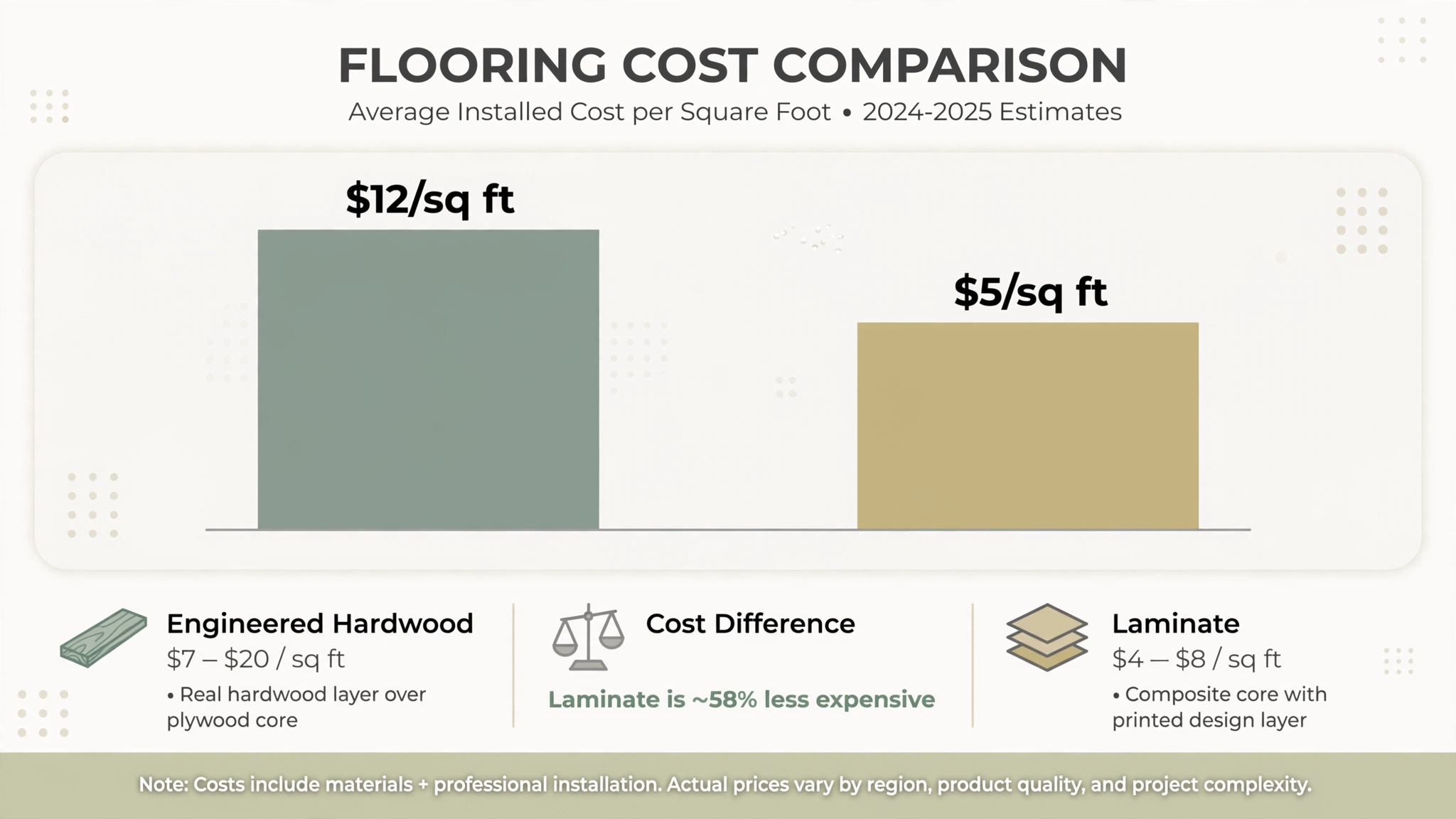
Laminate typically installs for a fraction of engineered hardwood’s cost, though the long-term value comparison depends on refinishing and resale factors.
Which One Is Actually Better for Pets?
This one catches a lot of homeowners off guard: laminate is generally the better choice for pet owners, not engineered hardwood. High-quality laminate with a strong wear layer (AC4 rating or higher) resists scratches from dog claws significantly better than any real wood surface, including engineered hardwood’s genuine wood veneer top layer. Real wood — even engineered wood — is inherently softer and more prone to scratching and denting from active pets than laminate’s hard resin wear layer.
If pet-proofing is your top priority, laminate (or a high-durability luxury vinyl plank) will generally outperform engineered hardwood day to day, even though engineered wood wins on authenticity and refinishing.
Which One Wins for Resale Value?
Here, the result flips: engineered hardwood is consistently viewed more favorably by real estate professionals and buyers than laminate. Because engineered flooring has a genuine hardwood surface, it reads as a premium feature much closer to solid hardwood — a material with well-established resale value. Laminate, while attractive and practical to live with, is generally recognized by buyers as an imitation product and typically adds little to no resale value by comparison.
Recent market data reflects this preference: industry analysis shows hardwood flooring (including engineered wood) demand rising in recent years while laminate demand has declined — a signal of which material buyers and builders are increasingly favoring for long-term value.
Room-by-Room: Which One Actually Fits
| Room | Better Choice | Why |
|---|---|---|
| Living room / main living areas | Engineered hardwood | Strongest resale value; benefits from a premium first impression |
| Bedrooms | Either works well | Both perform fine in lower-moisture, moderate-traffic spaces |
| Basements / slab-on-grade homes | Engineered hardwood (with proper install) or waterproof laminate | Standard laminate and solid hardwood are both risky over concrete without the right prep |
| High-traffic homes with pets or kids | Laminate | Stronger scratch resistance; lower cost if it needs replacing sooner |
| Budget renovations / flip projects | Laminate | Lower upfront cost, faster DIY installation |
| Homes staying long-term / planning to sell later | Engineered hardwood | Refinishing option and stronger resale value pay off over time |
If you’re weighing this decision against a full carpet-to-hardwood conversion instead, our guide on the cost to remove carpet and install hardwood breaks down that specific project’s pricing in more detail.
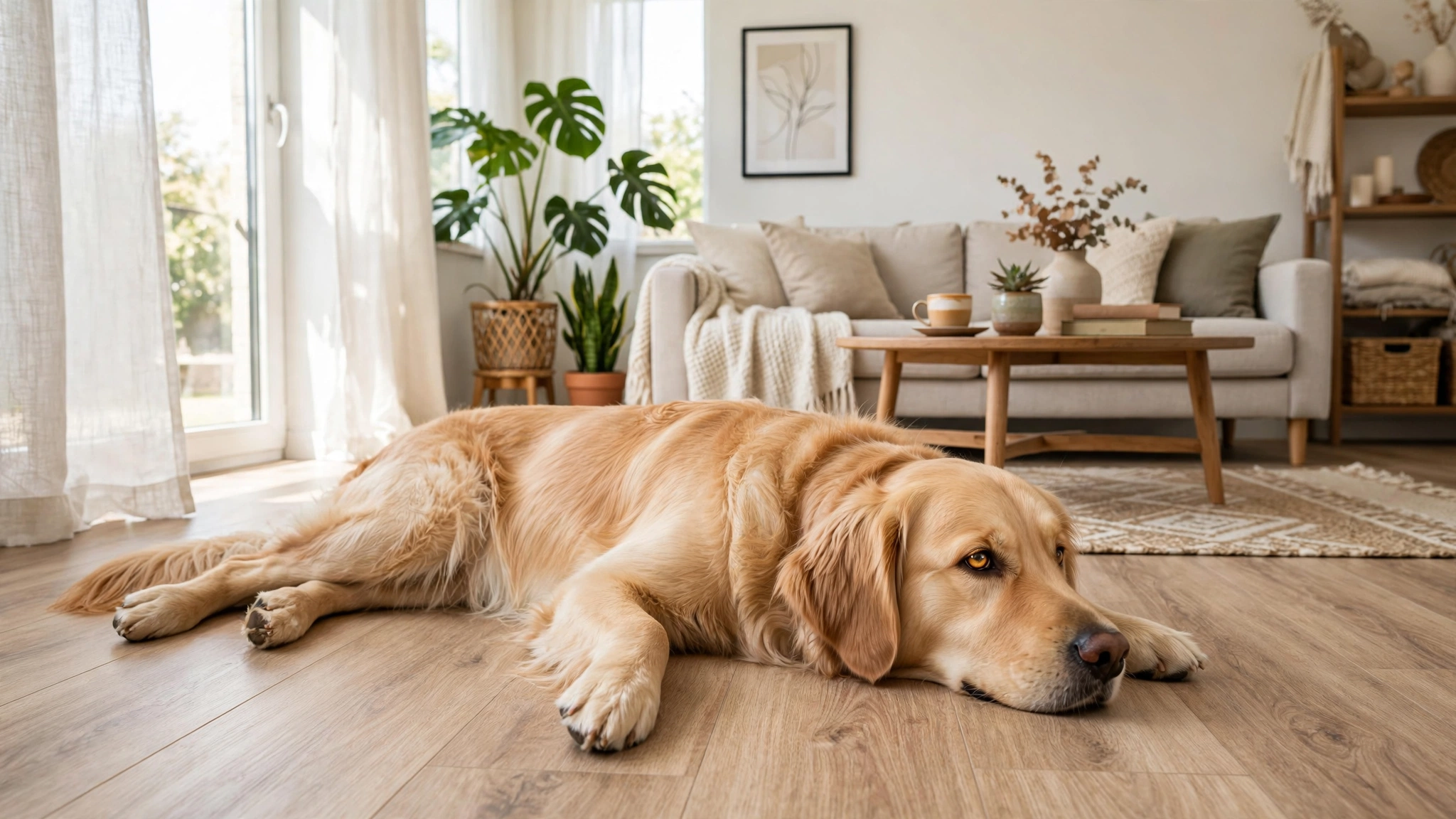
Laminate’s strong wear layer resists scratches from pet claws better than engineered hardwood’s real wood surface.
Installation Cost and Complexity
Laminate almost always installs as a simple floating floor — planks click together with no nails, staples, or glue, making it one of the more DIY-friendly flooring options available. Engineered hardwood offers more installation flexibility (it can be nailed, stapled, glued, or floated), which is part of why it can even be installed over concrete in basements, but that flexibility generally comes with higher professional installation costs than laminate’s straightforward click-lock system. If your subfloor needs prep work before either installation, our guide on what a subfloor is covers what to check first.
The Bottom Line
- Choose laminate if: budget, pet-proofing, and easy DIY installation are your top priorities.
- Choose engineered hardwood if: resale value, long-term durability through refinishing, and an authentic wood surface matter more to you than the lower upfront cost.
- Split the difference: many homeowners use engineered hardwood in main living areas (where resale impact matters most) and laminate in secondary spaces like basements or kids’ playrooms, balancing cost against value where it counts.
Frequently Asked Questions
Is engineered hardwood worth the extra cost over laminate?
It depends on your goals. If you’re staying long-term or plan to sell eventually, engineered hardwood’s stronger resale value and refinishing option often justify the higher upfront cost. If budget or pet-proofing is the priority, laminate is often the more practical choice.
Why is laminate better for dogs than engineered hardwood?
Laminate’s hard resin wear layer (especially AC4-rated or higher) resists scratches from dog claws better than engineered hardwood’s real wood surface, which is inherently softer and more prone to scratching despite being genuine wood.
How much does it cost to floor a 2,000-square-foot house with each material?
Roughly $12,000 to $30,000+ installed for engineered hardwood, versus roughly $4,000 to $12,000 installed for laminate, depending on product quality and regional labor rates.
Does engineered hardwood really last longer than laminate?
Yes. Engineered hardwood typically lasts 30 to 100 years with proper care and periodic refinishing, while laminate generally lasts 10 to 25 years and cannot be refinished once its wear layer is damaged.
Can I install engineered hardwood or laminate over concrete in a basement?
Laminate can generally be installed over concrete with a proper moisture barrier, and some engineered hardwood products are also rated for below-grade installation over concrete — but standard solid hardwood should not be installed directly over a concrete slab.
Want the full construction breakdown behind these numbers? Read our guide on the difference between laminate and engineered flooring, or explore more flooring cost and comparison guides on Ayaan Home Decor.
Last modified: August 8, 2026