Swapping old carpet for hardwood is one of the most requested home upgrades — it’s also one where the final bill can vary a lot more than homeowners expect. Between carpet removal, subfloor prep, and the wood itself, the total cost depends on several moving pieces. Here’s the full breakdown so you can budget accurately before calling a contractor.
Quick Answer: The total cost to remove carpet and install hardwood flooring typically runs $6 to $25 per square foot, or roughly $1,000 to $5,000+ for an average-sized room. Carpet removal alone costs about $0.50 to $3 per square foot, while hardwood installation ranges from $6 to $25 per square foot depending on the wood species, thickness, and labor rates in your area.
Below is a full cost breakdown by project stage, typical totals by room size, and the factors that push your price up or down.
Cost Breakdown by Project Stage
| Stage | Cost per Sq. Ft. | Notes |
|---|---|---|
| Carpet removal | $0.50 – $3.00 | Staple-down is cheaper; glued-down carpet costs more due to scraping labor |
| Padding & tack strip removal | Often included above | Can add extra cost if not bundled with removal |
| Subfloor repair/leveling | $1.50 – $5.00 | Only needed if the subfloor is uneven, squeaky, or damaged |
| Hardwood material | $3.00 – $22.50 | Varies enormously by wood species (pine is cheapest, walnut/teak most expensive) |
| Hardwood installation labor | $3.00 – $8.00 | Nail-down or floating install; glue-down labor runs higher |
| Total project (removal + install) | $6.00 – $25.00 | Full combined cost for a typical residential room |
What a Typical Room Actually Costs
Using a 200-square-foot room as an example (roughly the size of a standard bedroom or small living room):
- Carpet removal: $100 – $600
- Subfloor prep (if needed): $300 – $1,000
- Hardwood material + installation: $1,200 – $4,500+
- Estimated total: $1,600 – $6,000, depending on wood choice and subfloor condition
For a full-home project or larger open-concept space, costs scale up proportionally — which is exactly why measuring your actual square footage before requesting quotes matters. Our guide on how to determine square footage of a room walks through the exact steps for getting an accurate number before you budget.
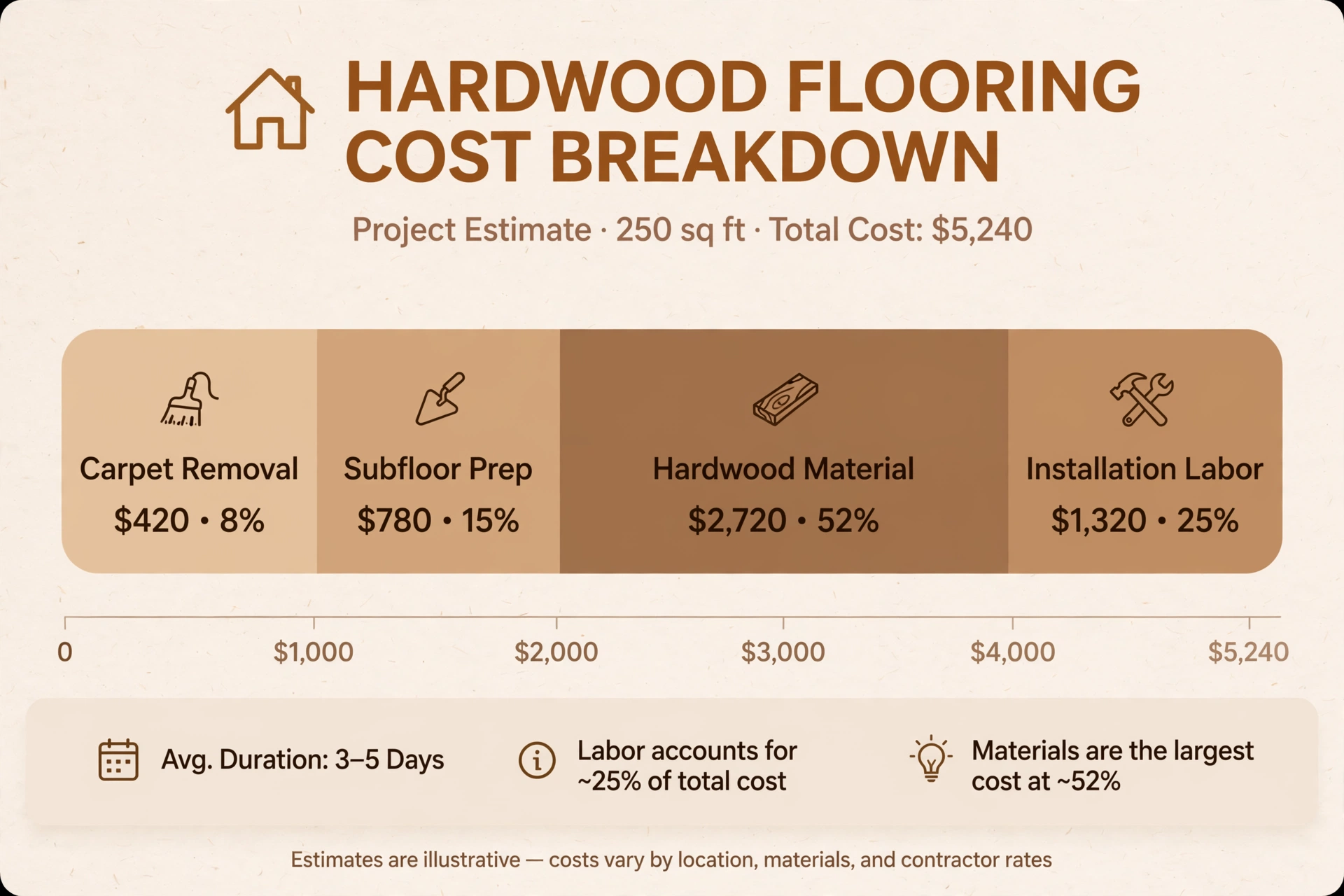
Hardwood material and installation labor typically make up the largest share of the total project cost.
Factors That Affect the Total Cost
1. Type of Wood
Wood species has the single biggest impact on material cost:
-
- Pine: The most budget-friendly domestic option
- Oak or maple: Mid-range, widely available, roughly $3–$8 per square foot for material
- Walnut or teak: Premium hardwoods, often reaching $15–$22.50+ per square foot for material alone
2. Carpet Removal Method
Standard staple-down carpet is the cheapest and fastest to remove, generally running $0.50–$1.60 per square foot. Glued-down carpet costs more, since it requires labor-intensive scraping to fully clear the adhesive before hardwood can be installed.
3. Subfloor Condition
If your subfloor is already flat, dry, and structurally sound, you may skip this cost entirely. If it needs leveling or repair — common in older homes — expect an additional $1.50 to $5.00 per square foot, or more for full self-leveling compound work.
4. Installation Method
- Nail-down or floating installation: Generally the most affordable labor, around $3–$6 per square foot
- Glue-down installation: Typically costs more due to the extra adhesive application steps
5. Room Complexity
Stairs, closets, and rooms with lots of corners or built-ins take longer to remove carpet from and install hardwood into, which increases labor costs compared to a simple, open rectangular room.
6. Your Location
Labor rates vary significantly by region — a contractor in a major metro area will typically charge more per square foot than one in a smaller market, even for an identical job.
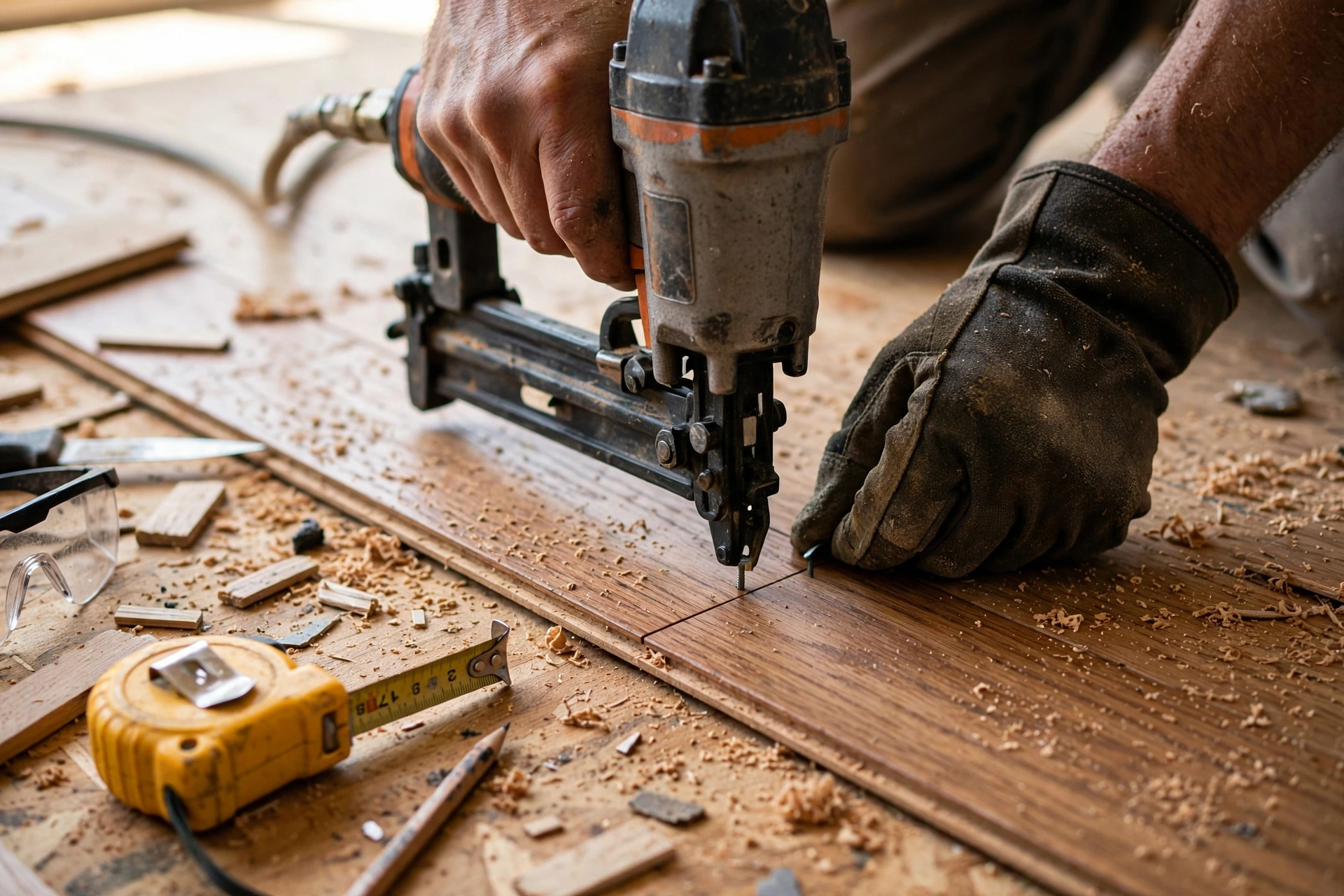
Nail-down installation is typically the most affordable labor method for hardwood flooring.
DIY vs. Professional: What You Can (and Shouldn’t) Skip
Removing the old carpet yourself is one of the more realistic DIY steps in this project, and it can save $300–$600 on a typical room. The process itself is straightforward — pulling up carpet, removing padding and tack strips, and hauling away the debris — though it’s dusty, physical work, and glued-down carpet is significantly harder to remove without professional tools.
Hardwood installation itself is generally better left to professionals, especially for nail-down or glue-down methods, since mistakes in subfloor prep or plank installation can be costly to fix later and may void material warranties. According to HomeGuide’s cost data, most pros will bundle carpet removal into the overall installation quote if you’re hiring them for both steps — always ask, since this can sometimes reduce your total cost compared to paying for removal separately.
Hidden Costs to Budget For
- Furniture moving fees — some contractors charge extra to move and store furniture during the project
- Disposal fees — old carpet and padding need to be hauled away, and dump fees vary by location
- Trim and transition strips — new baseboards or transition pieces between rooms typically run $4–$10 per linear foot
- HVAC vent adjustments — occasionally needed if the new floor height differs from the old carpet-and-pad height
- Permit fees — rarely required for flooring alone, but worth confirming with larger renovation projects
Is It Worth It? A Few Things to Consider
Hardwood flooring is widely considered one of the stronger home improvements for resale value, and it tends to hold up better than carpet in busy, high-traffic rooms over the long run. That said, if your main goal is durability and budget-friendliness rather than resale value specifically, it’s worth comparing hardwood against other options — our vinyl vs. laminate flooring guide covers two materials that cost significantly less than hardwood while still offering a wood-look finish.
Common Mistakes to Avoid
- Skipping subfloor inspection before getting quotes — an uneven or damaged subfloor can add thousands to a project that initially looked affordable
- Assuming carpet removal is always included in a hardwood installation quote — always confirm this explicitly with your contractor
- Choosing wood species based on price alone without factoring in how it will hold up in your specific room’s traffic level
- Forgetting disposal and trim costs, which can meaningfully add to the final bill if not budgeted upfront
Frequently Asked Questions
How much does it cost to remove carpet and install hardwood in an average room?
For a typical 200-square-foot room, expect to spend roughly $1,600 to $6,000 total, depending on the wood species chosen and whether subfloor repairs are needed.
Is carpet removal usually included in hardwood installation pricing?
Sometimes, but not always. Many contractors bundle it into the overall quote when hired for both removal and installation, but it’s important to confirm this directly rather than assume.
Can I remove the carpet myself to save money?
Yes, carpet removal is one of the more DIY-friendly parts of this project and can save $300–$600 on a typical room. Glued-down carpet is significantly more labor-intensive to remove than standard staple-down carpet.
What’s the cheapest wood option for a carpet-to-hardwood conversion?
Pine is generally the most budget-friendly domestic hardwood option, while oak and maple offer a solid mid-range balance of cost and durability. Walnut and teak sit at the premium end of the price range.
Does replacing carpet with hardwood increase home value? Hardwood flooring is widely considered a strong return-on-investment upgrade for resale value, and it’s often viewed favorably by buyers compared to older or worn carpet.
Before you get quotes, make sure you know exactly how much flooring you’ll need — our guide on how to determine square footage of a room walks through the math. Explore more flooring and renovation guides on Ayaan Home Decor.
Last modified: August 1, 2026