Concrete crews pour through the winter in nearly every cold-climate region, so the short answer to whether it can set in cold weather is clearly yes. The real question — the one that actually determines whether a cold-weather pour succeeds or fails — is how much slower it sets, and what happens if it freezes before it’s ready to handle that.
Quick Answer: Yes, concrete will set in cold weather, but the process slows dramatically — as a general rule, every 10 to 20°F drop in concrete temperature roughly doubles the setting time. Fresh concrete becomes vulnerable to serious, often permanent damage if it freezes before reaching about 500 psi of compressive strength, which typically takes around 24 to 48 hours under proper protection. The American Concrete Institute defines “cold weather concreting” as conditions where air temperature falls below 40°F, and most contractors avoid pouring below that threshold without special mix adjustments and protective measures.
Here’s what actually happens to concrete in cold temperatures, the thresholds that matter most, and how professionals successfully pour through the winter anyway.
Why Cold Temperatures Slow Concrete Down
Concrete hardens through hydration — a chemical reaction between cement and water that generates its own heat as it happens. In warm conditions, this reaction proceeds at a predictable pace. In cold conditions, the same chemical reaction simply runs slower, the same way most chemical reactions slow down as temperature drops.
- A drop of about 20°F in concrete temperature roughly doubles the setting time, according to industry guidance from the National Ready Mixed Concrete Association.
- Concrete cured at 30°F can take twice as long to set as concrete cured at 50°F.
- Below about 25 to 27°F, the water within the concrete mix itself begins to freeze, which is a fundamentally different and more serious problem than simply slow curing.
The Critical Threshold: 500 PSI
This is the number that matters most in cold-weather concrete work. Fresh concrete needs to reach roughly 500 psi of compressive strength before it can safely withstand a freezing cycle without permanent damage — a milestone that typically takes about 24 to 48 hours under proper cold-weather protection.
If concrete freezes before reaching this strength, the consequences are serious and irreversible:
- The concrete can lose up to 50% of its designed 28-day strength
- Surface scaling (flaking of the top layer) becomes far more likely
- Long-term durability suffers, with increased permeability that lets water and de-icing chemicals penetrate and cause further deterioration over time
- This damage typically isn’t visible right away — it often only becomes apparent well after the pour, once the concrete is already in service
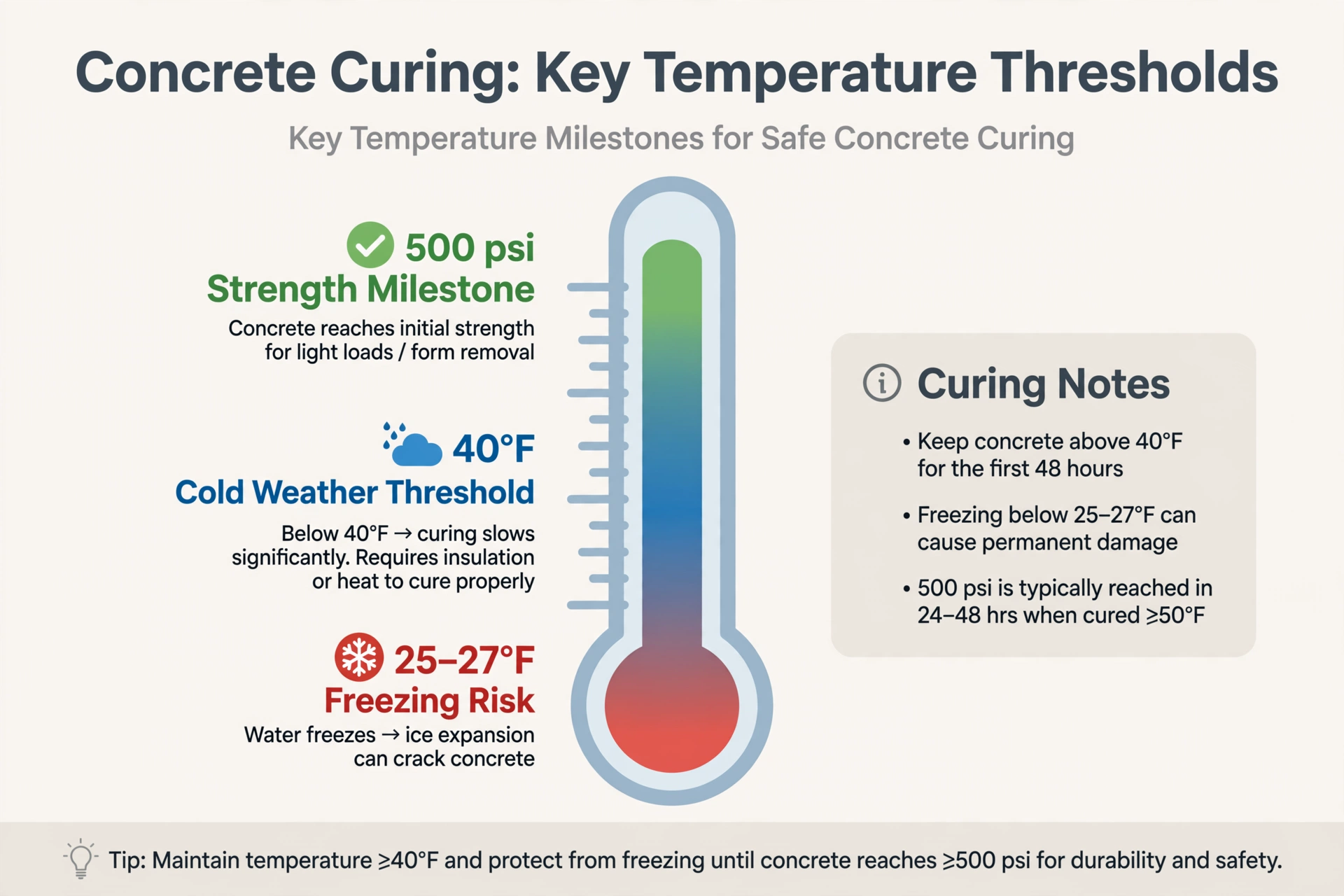
Concrete must reach roughly 500 psi of strength before it can safely withstand a freezing cycle.
How Professionals Successfully Pour Concrete in Winter
Despite the risks, concrete is poured through the winter constantly on job sites across cold climates. A few standard practices make this possible:
- Never pour on frozen ground. Frozen subgrade will settle unevenly as it thaws later, leading to cracking regardless of how well the concrete itself cured.
- Adjust the concrete mix. Producers often increase cement content, use accelerating admixtures, or reduce the water-to-cement ratio to speed up strength gain and improve cold-weather durability.
- Heat the materials. Mixing water is sometimes heated to 140°F or more (but generally not above 180°F) to raise the concrete’s starting temperature, and aggregates can also be pre-heated in extreme conditions.
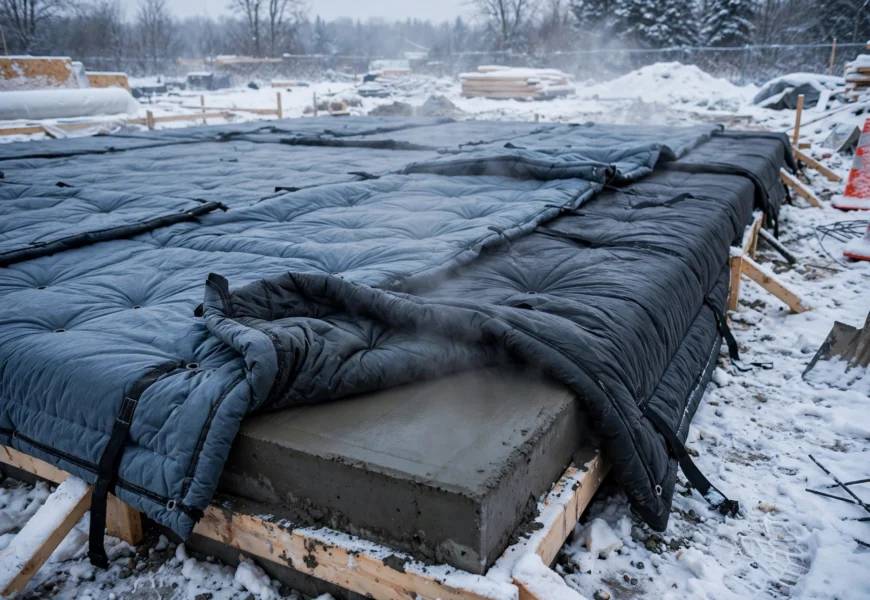
- Protect the pour after placement. Insulating blankets, temporary enclosures, or straw layered under waterproof covering help retain the heat generated by hydration and prevent freezing during the critical first 24 to 48 hours.
- Monitor temperature continuously, not just air temperature but the concrete’s actual internal temperature, since ground contact and wind chill can cause it to cure unevenly or drop faster than expected.
- Avoid sealing too early. Sealing freshly placed concrete traps water inside it, which can actually worsen freeze-thaw damage rather than prevent it.
According to Ozinga’s guidance on cold-weather concrete placement, placing concrete on a cold surface — even if the ground isn’t fully frozen — will still cause it to set more slowly than the top layer, creating uneven curing rates that can lead to cracking or scaling later on.
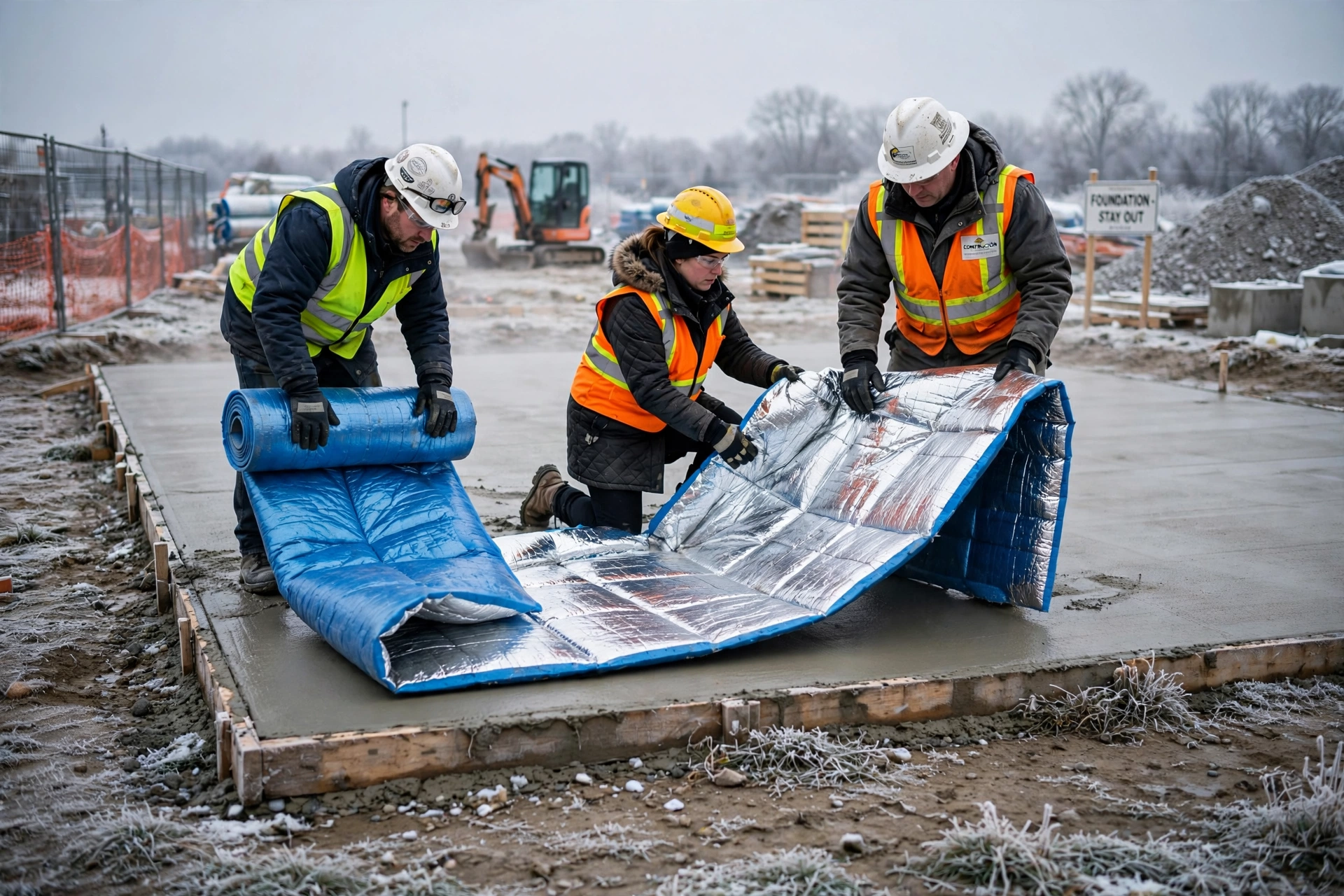
Insulating blankets help retain the heat generated by hydration, protecting fresh concrete from freezing during its critical first days.
When Is It Too Cold to Pour Concrete?
Most industry guidance draws the line at 40°F air temperature as the point where standard procedures need to shift to cold-weather protocols. Below that:
- The American Concrete Institute (ACI 306) defines cold weather concreting as conditions where air temperature has fallen to, or is expected to fall below, 40°F during the protection period.
- Many contractors still pour well below freezing with the right precautions — heated materials, insulated protection, and accelerated mix designs — but this requires more careful planning and monitoring than a standard warm-weather pour.
- According to NRMCA’s technical guidance (CIP 27), fresh concrete freezes once its temperature falls to about 25°F, and its potential strength can be reduced by more than 50% if this happens before it has developed adequate protection.
Common Mistakes in Cold-Weather Concrete Work
- Assuming 24 hours is always enough protection — actual time to reach 500 psi depends on the specific mix, temperature, and moisture conditions, and can take considerably longer below 50°F.
- Pouring directly onto frozen or snow-covered ground without addressing the subgrade first.
- Removing protective blankets or forms too early, exposing partially cured concrete to a freeze before it’s ready.
- Sealing the surface too soon, which traps moisture inside and can worsen freeze-thaw related damage.
- Ignoring wind chill’s effect on fresh concrete, which can accelerate heat loss well beyond what the ambient air temperature alone would suggest.
If you’re dealing with a concrete slab as part of a home flooring project rather than a fresh pour, our guide on what a subfloor is covers how concrete subfloors are typically prepared before flooring is installed, and our guide on whether hydraulic cement bonds to concrete covers repairing existing concrete cracks and leaks.
Frequently Asked Questions
Can concrete set below freezing temperatures?
Concrete can technically continue setting in sub-freezing air temperatures if the concrete itself is kept warm enough through heated materials and insulation, but if the concrete’s own temperature drops to around 25–27°F, the water inside it will freeze, halting hydration and risking permanent strength loss.
How much does cold weather slow down concrete setting time?
As a general rule of thumb, every 10 to 20°F drop in concrete temperature roughly doubles the setting time compared to concrete cured at a moderate temperature like 50–70°F.
What temperature is too cold to pour concrete?
Most industry guidance considers 40°F air temperature the threshold where standard cold-weather concreting practices (ACI 306) become necessary. Pours can still succeed below that with proper heating, insulation, and mix adjustments.
What happens if concrete freezes before it cures?
If concrete freezes before reaching about 500 psi of compressive strength, it can permanently lose up to 50% of its designed strength, along with increased risk of surface scaling and long-term durability problems.
How long does concrete need to be protected from freezing after pouring?
Concrete generally needs protection from freezing for the first 24 to 48 hours to reach the critical 500 psi threshold, though some guidance recommends maintaining protection for 3 to 7 days, or longer in more extreme cold, for the strongest long-term results.
Working with concrete as part of a home renovation? Explore our guides on what a subfloor is and whether hydraulic cement bonds to concrete, or browse more home improvement guides on Ayaan Home Decor.
Last modified: August 24, 2026