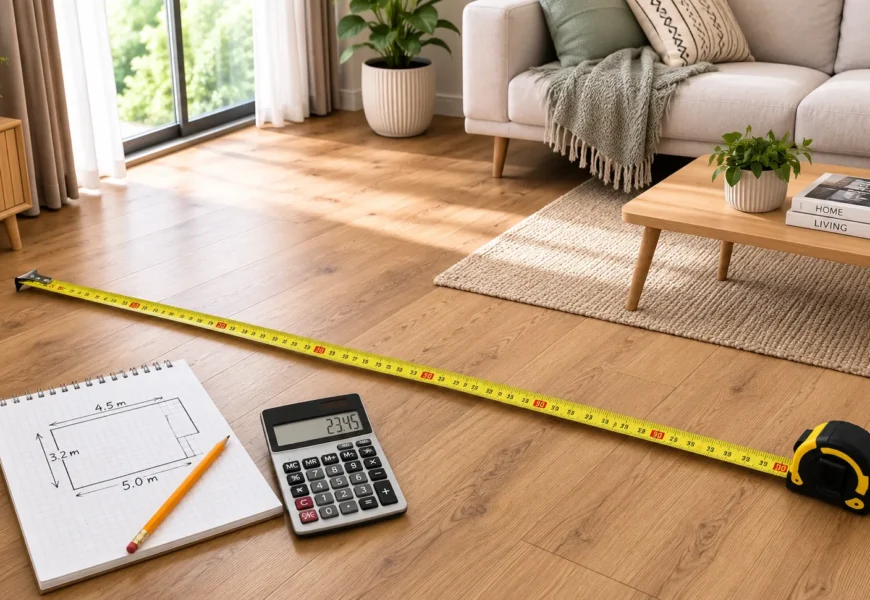
If you’ve ever stood in the middle of a room with a tape measure wondering “okay, now what do I actually do with these numbers,” you’re not alone. Calculating square footage sounds technical, but it’s really just one simple formula applied a few different ways depending on your room’s shape.
Quick Answer: To determine the square footage of a room, measure the length and width in feet, then multiply them together (Length × Width = Square Footage). A room that is 12 feet long and 10 feet wide is 120 square feet.
Below, we’ll walk through the exact steps for rectangular rooms, irregular layouts, circular spaces, and multi-room homes — plus the common mistakes that throw off flooring and paint calculations.
Why You Need to Know Your Room’s Square Footage
Getting this number right matters more than most people expect. It’s the foundation for:
- Flooring and carpet orders — so you buy the right amount of hardwood, tile, or carpet without a second trip to the store
- Paint calculations — knowing your wall area helps you estimate how many gallons you’ll need
- Furniture planning — understanding how much floor space you actually have to work with before you shop
- Home value and real estate listings — square footage is one of the key numbers buyers and appraisers look at
- Rent and space comparisons — useful if you’re comparing apartments or commercial spaces
If you’re redoing a room’s flooring or repainting the walls, it’s worth reading this alongside our guide on the difference between wall tile and grout and wall paint vs. trim paint, since both projects start with an accurate square footage number.
What You’ll Need
- A tape measure (a laser measuring tool works too, and is faster for larger rooms)
- A pen or pencil and paper, or a notes app on your phone
- A calculator (or your phone’s calculator app)
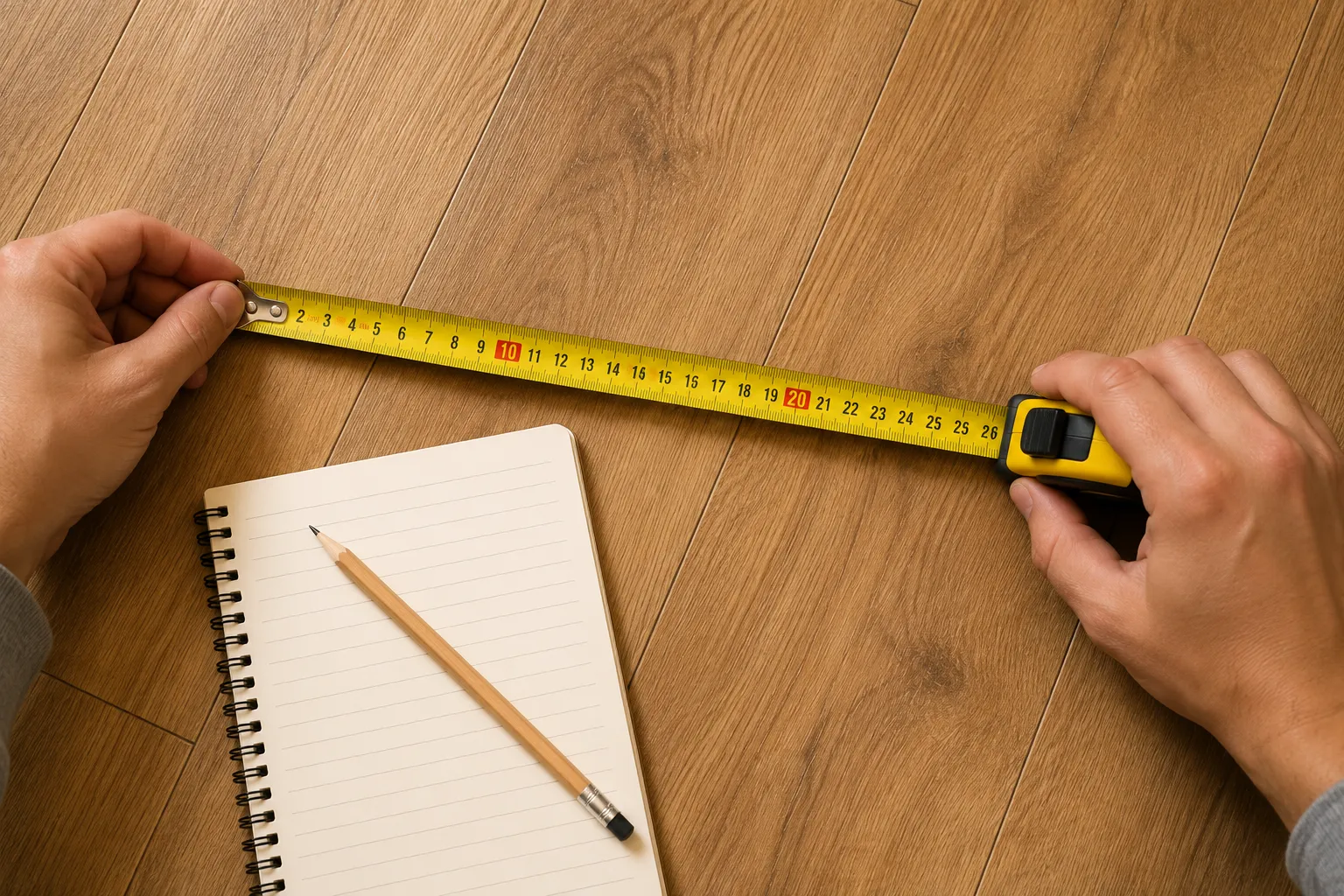
A tape measure, notepad, and calculator are all you need to get started.
Step 1: Measure the Length and Width
For a standard rectangular or square room:
- Measure the length of the room from one wall to the opposite wall.
- Measure the width the same way, along a wall perpendicular to the length.
- Round to the nearest inch for accuracy, then convert inches to decimal feet if needed (divide the inch value by 12).
For example, if a wall measures 11 feet 6 inches, that’s 11 + (6 ÷ 12) = 11.5 feet.
Step 2: Multiply Length × Width
Once you have both measurements in feet, multiply them:
Length × Width = Square Footage
Example: A room measuring 12 feet by 10 feet = 12 × 10 = 120 square feet.
This is the formula you’ll use for the vast majority of rooms in a typical home — bedrooms, living rooms, kitchens, and offices are almost always rectangular or square.
Step 3: Adjust for Irregular or Multi-Section Rooms
Not every room is a perfect rectangle. If your space has an alcove, a nook, an L-shape, or an angled wall, break it into smaller rectangular sections and calculate each one separately.
- Divide the room into two or more rectangular sections on paper.
- Measure the length and width of each section.
- Calculate the square footage of each section individually.
- Add all the section totals together for the final square footage.
Example — L-shaped room:
- Section A: 3 ft × 7 ft = 21 sq ft
- Section B: 12 ft × 10 ft = 120 sq ft
- Total: 21 + 120 = 141 square feet
Calculating a Circular Room or Area
If you’re measuring a round space, like a circular seating nook, use this formula instead:
Area = π × radius²
Measure the radius (the distance from the center to the edge) and square it, then multiply by π (3.14159). If you only know the diameter, divide it by 2 to get the radius first.
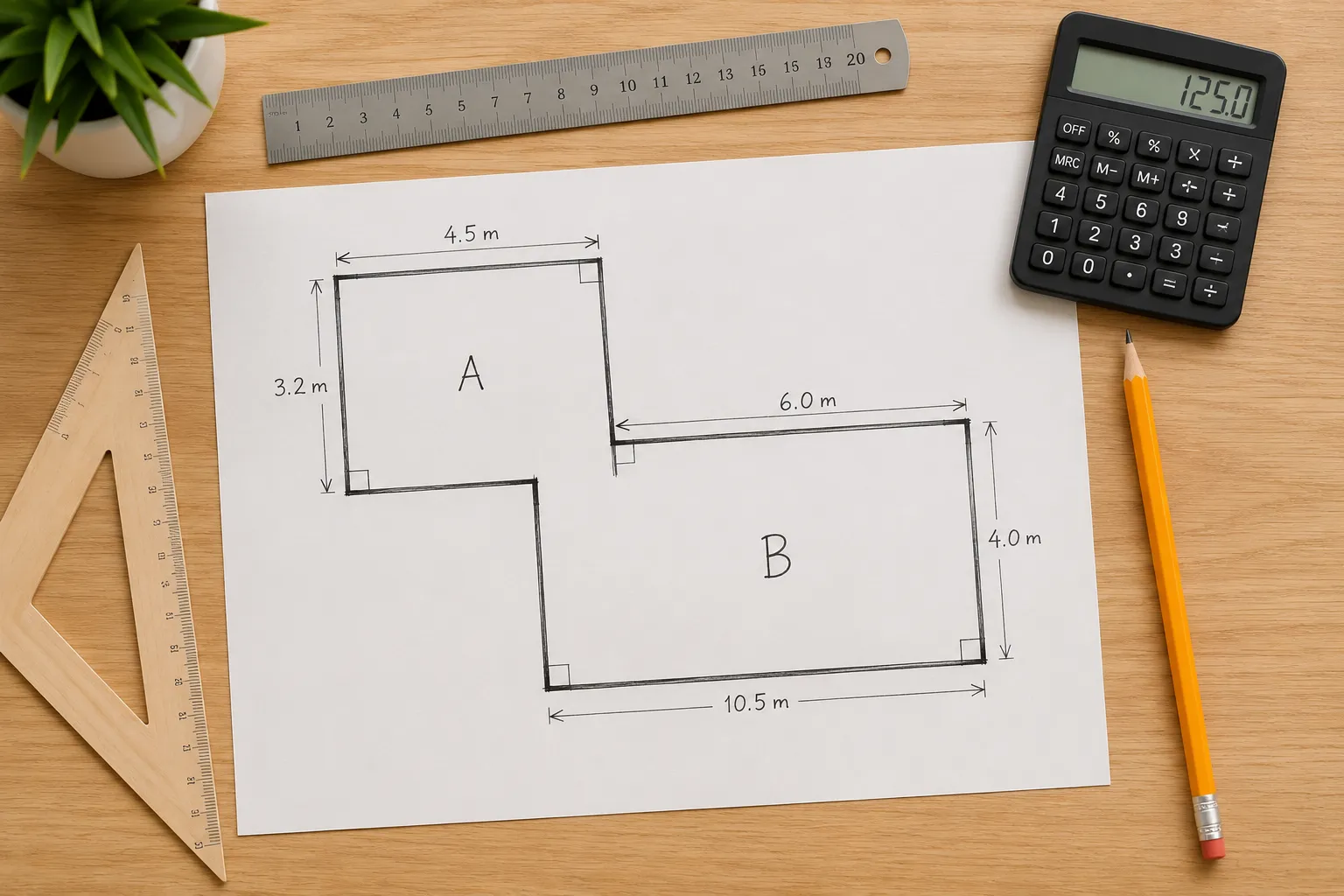
Splitting an L-shaped room into two rectangles makes the math simple.
Calculating Square Footage for an Entire House
To find the total square footage of a home, repeat the same process for every room — including hallways and closets — then add all the totals together.
A few things to keep in mind, especially if you’re calculating “livable” square footage for a real estate listing or appraisal:
- Include: finished, heated living space with ceilings at least 7 feet high
- Exclude: unfinished attics or basements, garages, enclosed porches that aren’t heated the same as the rest of the house, and below-grade basement space, even if it’s finished
Common Mistakes to Avoid
- Forgetting to convert inches to decimal feet before multiplying — mixing units will throw off your entire calculation
- Measuring only one wall and assuming the opposite wall is identical (rooms aren’t always perfectly square)
- Ignoring alcoves or nooks, which can under- or overstate your material needs
- Ordering flooring with zero buffer — most professionals recommend adding 5–10% extra for cuts and waste
If you’re planning a flooring refresh, it also helps to know how to handle everyday floor care once it’s installed — our guide on removing coffee stains from carpet is a good one to bookmark alongside this.
Square Footage Formula Cheat Sheet
| Room Shape | Formula |
|---|---|
| Rectangle / Square | Length × Width |
| L-Shaped / Irregular | Sum of each rectangular section |
| Circle | π × radius² |
| Whole House | Sum of all room totals (finished space only) |
Frequently Asked Questions
How do I calculate square footage if my measurements are in inches? Convert inches to decimal feet first by dividing the inch value by 12, then multiply length by width as usual.
Does square footage include closets and hallways? Yes, when calculating the total square footage of a house, closets and hallways are typically included. For a single room’s flooring or paint project, you’d generally measure the room itself.
How much extra flooring should I buy after calculating square footage? Most flooring professionals recommend ordering 5–10% more than your calculated square footage to account for cuts, waste, and pattern matching.
Is square footage the same as carpet area? Not always — for carpet purchases, retailers sometimes round up to the nearest roll width, so your actual carpet area purchased may be slightly larger than your room’s square footage.
Looking to finish your flooring project the right way? Explore more home improvement guides on Ayaan Home Decor for tips on furniture, paint, and interior styling.
Last modified: July 26, 2026