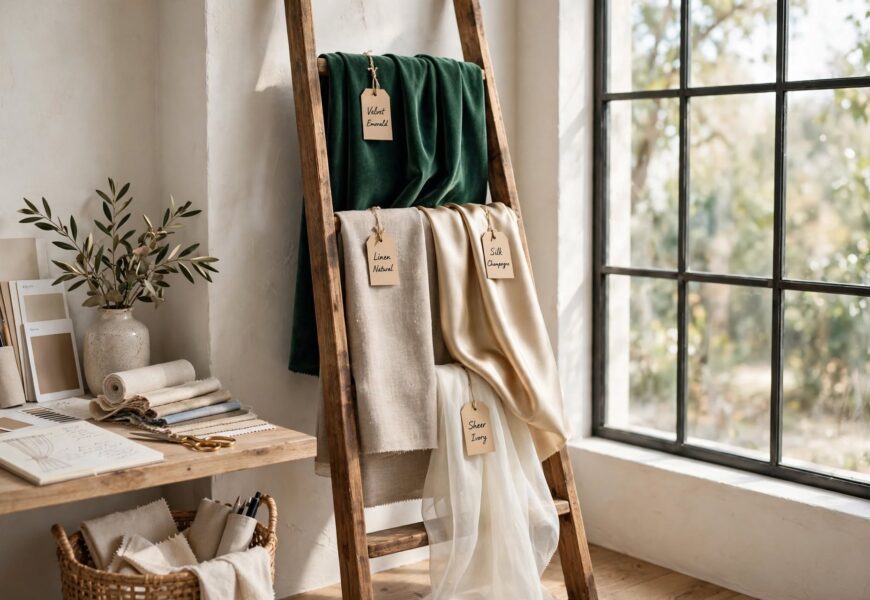
Quick answer: To choose drapes for your home, decide the job first (light-blocking, privacy, insulation, or purely decorative), then pick a fabric that matches it — blackout or velvet for bedrooms, linen or light-filtering fabric for living rooms, silk for formal low-traffic rooms, and cotton or polyester blends for high-traffic spaces. Get the fit right last: panels roughly 1.5–2.5 times the window’s width, a rod mounted 4–6 inches above the frame, and extended 8–12 inches beyond it on each side.
Choosing drapes for your home can feel more complicated than it should be — not because the options are bad, but because there are simply a lot of them. Fabric, color, length, heading style, and function all interact with each other, and getting one wrong can throw off the whole room.
The good news is that the decision gets much easier once you work through it in the right order: function first, then fabric, then the finer details of fit and style. Here’s how to do that, room by room.
Step 1: Decide What Job the Drapes Need to Do
Before you look at a single color or pattern, answer this: what do you actually need the drapes to do in this room?
- Block light — bedrooms, nurseries, media rooms
- Add privacy — street-facing rooms, ground-floor windows
- Insulate against heat or cold — rooms with older or single-pane windows
- Soften the room and filter light — living rooms, dining rooms where full blackout isn’t the priority
- Purely decorative framing — rooms that already have blinds or shades doing the functional work underneath
According to Crate & Barrel’s design guide, thinking about how curtain panels will add to a room’s visual space — not just its function — is just as important, since the wrong choice can throw off how cohesive a room feels overall.
Step 2: Match the Fabric to That Function
Once you know the job, the fabric almost picks itself:
- Blackout drapes — heavy, often lined fabric that blocks nearly all outside light. Best for bedrooms and media rooms.
- Velvet — heavy and richly textured, velvet drapes help with light-blocking, insulation, and sound dampening, making them a strong pick for formal living rooms and bedrooms alike.
- Linen — breathable, textured, and light-filtering rather than light-blocking. A popular, versatile choice for living and dining rooms.
- Sheer — lightweight and semi-transparent, sheers filter light and add softness without much privacy, and are often layered with a heavier drape rather than used alone.
- Silk — refined, with a natural sheen, silk drapes elegantly but needs gentler care, so it suits formal or lower-traffic rooms better than busy family spaces.
- Cotton and polyester blends — durable and easy to maintain, a practical choice for high-traffic rooms or homes with kids and pets.

Matching fabric to function first makes every other decision easier.
Step 3: Choose a Color and Pattern Strategy
With function and fabric settled, color is where personal taste comes in — but a few guiding principles make it easier:
- Solid, neutral drapes are the safest and most flexible choice, especially in a room that already has pattern elsewhere (a rug, upholstery, art).
- Tone-on-tone — a shade slightly darker or lighter than the wall — adds quiet depth without introducing contrast.
- Bold or patterned drapes work well when the window is meant to be a focal point and the rest of the room is kept relatively simple.
- Matching the wall color creates a calm, monochromatic look that can make a room feel more spacious, since the window essentially disappears into the wall.
Step 4: Get the Fit Right
Once you’ve chosen fabric and color, fit is what makes drapes look custom rather than off-the-rack. As a general set of proportions:
- Curtain panels should be roughly 1.5 to 2.5 times the width of the window when closed, so they hang with proper fullness rather than looking flat and stretched.
- Mount the rod 4 to 6 inches above the window frame, and extend it 8 to 12 inches beyond the frame on each side, so the panels can stack fully off the glass.
- Choose a rod diameter that matches the fabric weight — a thin rod will bow under heavy velvet, while a chunky rod can overwhelm delicate sheers. A 1 to 1.5 inch diameter works for most standard drapes.
Step 5: Match Drapes to the Room
Putting it all together, here’s a quick reference for common rooms:
- Bedroom: Blackout or velvet, for light control and a cozy, enclosed feel
- Living room: Linen or a light-filtering fabric, often paired with a sheer layer
- Dining room: Silk or a refined solid fabric, since these rooms see less daily wear
- Nursery: Blackout, prioritizing sleep quality over decorative pattern
- Home office: Light-filtering or blackout, depending on whether screen glare or natural light is the bigger concern.

Bedrooms are usually the one room where function should lead the decision.
A Few Rules of Thumb to Keep in Mind
- When in doubt, choose a solid neutral over a bold pattern — it’s far easier to live with long-term and pairs with almost any future decor changes.
- Don’t buy drapes before measuring the actual wall and window height; a beautiful fabric in the wrong length will look off no matter how well it was chosen otherwise.
- If a room genuinely needs both light-blocking and a decorative look, layering a blackout lining behind a prettier face fabric solves both problems at once, rather than compromising on either.
Frequently Asked Questions
What’s the difference between curtains and drapes?
Curtains are typically lighter, unlined, and more casual, while drapes are heavier, often lined, and provide better insulation, light control, and a more formal look.
What type of drapes are best for a bedroom?
Blackout or velvet drapes are generally best for bedrooms, since they block outside light and add insulation, which supports better sleep quality.
How wide should drapes be compared to the window?
Drapes should generally be 1.5 to 2.5 times the width of the window when closed, so they hang with enough fullness rather than looking flat.
Do drapes need to match across every room in the house?
No — style and color can vary by room, but keeping the same general formality level (all casual, or all more tailored) throughout a home tends to feel more cohesive.
Once you’ve chosen the right drapes, how you hang and arrange them in the room matters just as much as the fabric itself. Our guides on how to dress up a window with curtains and how to arrange curtains for a living room cover the height, width, and layering details that bring a chosen fabric to life.
See Different Drapes in Your Own Home First
Fabric swatches can look completely different once they’re actually hanging in your room’s light. Upload a photo of your space to Ayaan Decor and get an AI-generated design mockup showing how different drape fabrics, colors, and lengths would really look before you commit to a purchase.
Sources referenced:
- Crate & Barrel — How to Choose Curtains for Living Rooms, Bedrooms & Windows
- Live to Plant — The Ultimate Guide to Selecting Drapes for Every Room
- Pepper Home — What Is the Best Type of Drapes for Living Room?